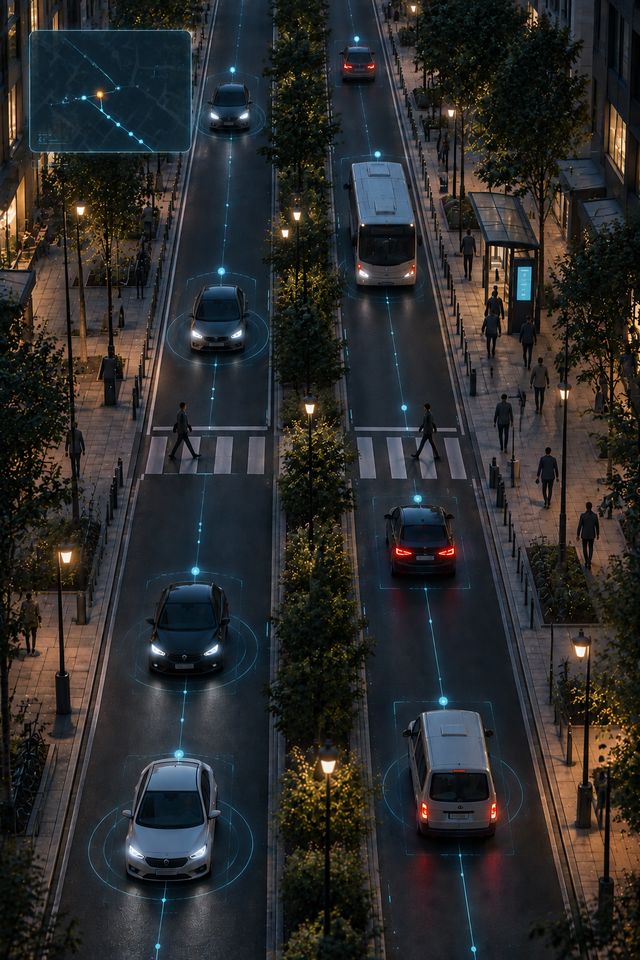
For me, optimization is ultimately about making the best decision that can be
justified with the information available at the time. Transport information is
rarely complete, and waiting for it to become complete has a cost of its own.
I start by understanding the decision: what has to be decided, which constraints
apply, what evidence exists and which alternatives are realistic. Then I choose
the best defensible option with what is known, and reassess it once reality
provides new information. Models matter because they give this process
structure; their complexity is worth only what it adds to the decision.
I arrived at this view by meeting transport problems from several sides:
optimization for flexible public transport, the regulatory and budget constraints
of public administration, vehicle data in which the relevant variable had to be
inferred, and automated electric services running under uncertainty. Each moved
my work closer to the point where analytical models have to become operational
decisions.
Scheduling, charging and operational adaptation for an experimental
electric shuttle service.
2024 – 2025European research institution
Applied data science
Vehicle energy modelling from real-world telemetry and instrumented
driving data, including the reconstruction of variables not directly
reported by the vehicle.
2019 – 2024Doctoral research · Belgium
Demand-responsive transport
Optimization of flexible public transport services under capacity and
operational constraints.
2017 – 2019Municipal administration · Brazil
Public sector
Transport planning, bus concessions, regulation and mobility policy, first
leading a municipal transport department and later serving as deputy head of
transport in a state capital.
2016 – 2023Universities in Brazil and Belgium
Teaching
Operations research, programming and transport-related quantitative
methods, with supervision of student research.
OngoingIndependent project
HELMET
An exploratory project on decision support for electric
demand-responsive operators, carrying the offline and online architecture
from the research into a product concept.
Optimization of a semi-flexible demand-responsive feeder bus system using variable neighborhood search
International Transactions in Operational Research · 2025
Optimization of a semiflexible demand-responsive feeder system in suburban areas using a memetic algorithm
Journal of Advanced Transportation · 2023
A survey on demand-responsive public bus systems
Transportation Research Part C · 2022
Hierarchical optimization for resilient real-time operation of automated electric shuttle services
INSTR · 2026
Fleet sizing and scheduling for battery-electric automated shuttles using Benders decomposition
ICTS · 2026
Optimizing a demand-responsive feeder system for low-demand areas
hEART · 2022
Behaviour and safety
Drivers' speed profile at curves under distraction task
Transportation Research Part F · 2017
Driving-simulator validation and eye-fixation analysis under mental workload
ANPET · 2014–2017
Road safety on five continents
RS5C · 2018
Vehicle energy and data
Benchmarking the real-world energy benefits of vehicle-integrated photovoltaics
Transport and Pollution (TaP) Conference · 2025 · co-author
Unveiling the energy impact of vehicles' automation: a first empirical estimation
TRB Annual Meeting · 2025 · contributor
Recognition
Cátedra Abertis Prize for the master's dissertation in transportation engineering.
Training
Delft Road Safety Course for Latin America, TU Delft · 2018
Machine Learning for Earth Systems Modelling, ECMWF three-course online series · 2026
I am interested in research collaboration, applied optimization and data-science
work in mobility, and roles where analytical methods and transport operations meet.